
Make sure every victory of a mobile app does not fade out. I can tell your achievements are an result of your well-designed marketing funnel set up behind the scenes, it attracts potential users to learn about the app and stick around until they can no more imagine living without it.
Introduction If you want to expand your mobile app’s downloads, engagement and retention, understanding the marketing funnel is essential. This blog walks through what a mobile app marketing funnel actually entails, key stages involved and actionable tips for optimizing each step.
What Is the Mobile App Marketing Funnel?
The mobile app marketing funnel is a framework that maps the customer’s entire experience, from discovering your app to making it an integral part of their daily lives.
Think of it as a roadmap that guides users along their customer journey, step by step, from awareness to acquisition, retention, and advocacy. If you’re not strategically managing every stage of this process, you’re leaving growth up to chance.
Read more: How to Market an App: A Step-by-Step Guide
Why the Funnel Matters
With millions of apps vying for attention in app stores, the marketing funnel ensures two key things:
- Focus: It helps you prioritize marketing strategies for specific stages in the user lifecycle.
- Better Conversions: The funnel works to not just get users in the door (downloads) but convert them into active, paying customers.
Now, let’s break it down stage by stage.
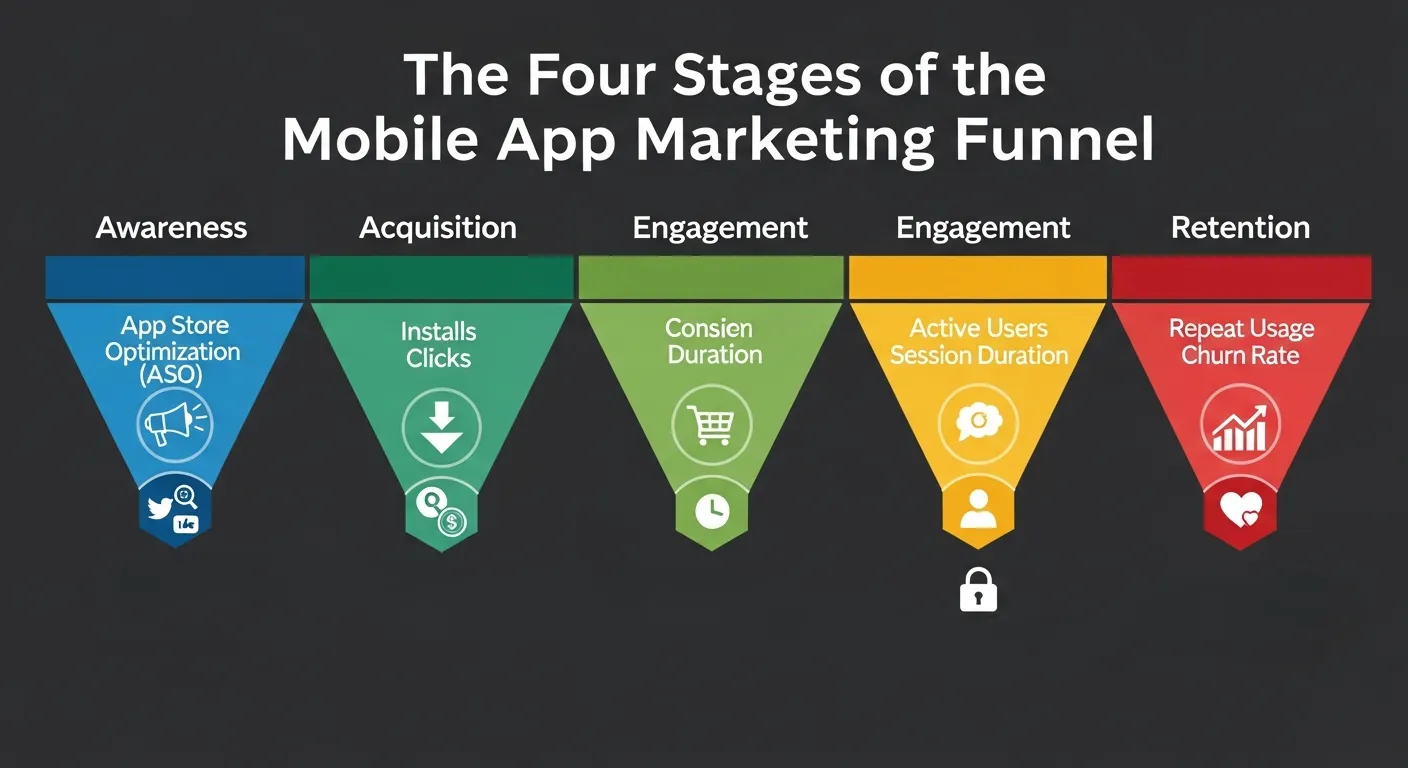
The Four Stages of the Mobile App Marketing Funnel
1. Awareness
Getting your app in front of potential users is the first challenge. Most people won’t search for your app in the marketplace unless they know about it, which is why this stage is about creating visibility.
Key Strategies for Awareness
- Paid & Organic Social Media Ads
Platforms like Facebook, Instagram, and TikTok are prime for promoting your app’s features. Use videos and graphics to grab attention.
- Influencer Marketing
Leverage influencers in your niche to talk about your app. Whether they’re gamers, productivity enthusiasts, or fitness gurus, their followers trust their recommendations.
- App Store Optimization (ASO)
Ensure your app ranks well in Google Play and the Apple App Store. Optimize your title, description, and screenshots using search-friendly keywords.
Example
For example, an e-learning app can create free, valuable resources (like 1-minute “how-to” videos) on platforms like TikTok to catch the attention of curious learners.
2. Acquisition
Success isn’t just getting users to visit your app page. It’s about convincing them to download the app.
Key Strategies for Acquisition
- Clear Value Proposition
What problem does your app solve? Highlight this in every ad, app store description, and landing page.
- Limited-Time Offers
Entice users to download with an incentive like free trials or discounts for premium features.
- User Reviews & Ratings
Social proof has power. Apps with strong user ratings are far more likely to be downloaded. Encourage satisfied users to leave a review.
Data to Keep in Mind
The average conversion rate for app store pages is 30%. Optimizing your app icon, reviews, and preview videos can significantly boost this figure.
3. Retention
Most new downloads uninstall apps after just one use. Keeping users engaged is where the funnel gets tricky, but rewarding.
Key Strategies for Retention
- Onboarding Experience
First impressions matter. A seamless, interactive onboarding process ensures users quickly understand your app’s value.
- Push Notifications
Carefully-timed notifications can nudge users to return. For instance, a fitness app might send reminders to log workouts or drink water.
- Gamification
Add incentives like achievements, rewards, or badges to give users reasons to stick around.
Real-Life Example
Duolingo, the language-learning app, is great at gamification. With daily streaks, notification reminders, and progress graphs, they’ve built a habit-forming product that brings users back daily.
4. Advocacy
Happy users lead to word-of-mouth marketing, one of the most powerful yet underrated growth channels. Advocacy is about turning satisfied users into brand ambassadors who recommend your app to others.
Key Strategies for Advocacy
- Referral Programs
Offer users discounts, credits, or exclusive features if they successfully invite their friends to the app.
- Encourage Social Sharing
Integrate easy-to-use “share” buttons or features that highlight user-generated content (like game scores or fitness milestones).
- Exclusive Content for Advocates
Reward loyal customers with early access to features or special giveaways.
Example
Dropbox is an iconic example of leveraging advocacy with its referral program, where users were rewarded with free storage space for every friend who joined.
Optimizing Your Mobile App Marketing Funnel

Now that you understand the funnel’s key stages, here are some bonus tips to maximize its potential across the board.
Use Data-Driven Insights
Track user behavior to identify drop-offs in your funnel. Are users uninstalling during onboarding? Are they abandoning carts in your in-app store? Tools like Mixpanel, Google Analytics, and Amplitude can help pinpoint and resolve these issues.
Personalize User Experiences
Use AI and machine learning to tailor your app’s content and messaging to each user’s preferences. This creates a more enjoyable customer experience, increasing retention.
Constantly Test Campaigns
Whether it’s app store descriptions or onboarding copy, always test variations to see what performs best. Even small tweaks (like changing the color of your “Sign Up” button) can have a measurable impact.
Keep Up with Evolving Trends
Mobile app users expect convenience, speed, and relevance. Stay ahead by optimizing regularly and integrating feedback into future updates.
The Role of User Experience in Mobile App Marketing
A seamless and intuitive user experience is the cornerstone of powerful mobile app marketing. Even the best marketing campaigns cannot retain users if the app itself is difficult to navigate or slow to respond. Designing an app that feels effortless encourages users to engage repeatedly, increasing retention and lifetime value. Mobile app marketing networks increasingly emphasize that user satisfaction drives organic growth through word-of-mouth and social sharing. Optimizing user onboarding, simplifying navigation, and minimizing friction points ensures that users quickly understand the value your app provides. Ultimately, combining a thoughtful UX with targeted campaigns creates a feedback loop where engagement fuels more downloads, which further amplifies marketing efforts. In this ultimate guide mobile app success, UX is not merely an aesthetic choice; it is a strategic tool that enhances every stage of the marketing funnel, from awareness to advocacy. By prioritizing user experience alongside marketing strategies, businesses position themselves for long-term growth and a strong competitive edge in crowded app marketplaces.
Harnessing Content Marketing for Mobile App Growth
Content marketing has emerged as an essential tactic in marketing mobile app success. Blogs, video tutorials, social media posts, and podcasts offer a way to educate users, demonstrate the app’s value, and build a loyal community. The ultimate guide mobile app marketing consistently shows that providing valuable content strengthens engagement and trust, encouraging both downloads and repeat usage. By sharing how-to guides, tips, and behind-the-scenes insights, app developers can reach audiences before they even search for the app. This approach is especially effective when combined with mobile app marketing networks that amplify content distribution through targeted campaigns. Beyond brand awareness, content marketing can reinforce retention by reminding users of the app’s utility in their daily lives. For mobile app marketing professionals, integrating content strategies with paid ads, influencer campaigns, and ASO ensures that every user touchpoint aligns with the overarching goal: attracting, converting, and retaining loyal app users.
Email Marketing as a Growth Engine
Email marketing continues to be one of the most reliable channels for driving conversions and engagement in mobile app marketing. When executed strategically, emails can provide personalized recommendations, announce new features, or offer special promotions that bring users back into the app. Mobile app marketing networks often highlight the importance of segmentation and targeted messaging to ensure relevance and maximize open rates. In the ultimate guide mobile app marketing, email campaigns are positioned not just as a communication tool but as a mechanism for building long-term relationships. Triggered messages, such as welcome emails, milestone notifications, or reminders, can significantly reduce churn and reinforce retention. Integrating email marketing with push notifications and in-app messages creates a cohesive multi-channel strategy, amplifying the impact of each touchpoint. For businesses looking to boost user lifetime value, email marketing is a powerful and cost-effective way to maintain engagement while driving repeat actions and revenue.
Leveraging Social Proof to Enhance Conversions
Social proof is a critical element of powerful mobile app marketing. Positive reviews, ratings, testimonials, and influencer endorsements provide potential users with validation that the app delivers real value. Mobile app marketing networks increasingly highlight that apps with strong social proof convert at higher rates, as users trust the experiences of their peers. Highlighting success stories and user-generated content within the app, on social media, and through paid campaigns reinforces credibility and encourages adoption. The ultimate guide mobile app marketing emphasizes that social proof should be integrated into every stage of the marketing funnel. From acquisition through advocacy, demonstrating that others benefit from the app makes new users more likely to engage and existing users more likely to remain loyal. As the mobile app ecosystem becomes increasingly competitive, leveraging social proof effectively can be the differentiator that drives sustained growth and a loyal customer base.
Future-Proofing Your Mobile App Marketing Strategy
The landscape of mobile app marketing is constantly evolving, and staying ahead requires strategic foresight. Emerging trends such as AI-driven personalization, augmented reality experiences, and voice search optimization are reshaping how users discover and interact with apps. Powerful mobile app marketing incorporates these innovations to ensure long-term relevance and competitive advantage. The ultimate guide mobile app marketing stresses the importance of monitoring analytics, testing new channels, and adapting campaigns to evolving user behaviors. By future-proofing marketing strategies, app developers can anticipate user needs, increase engagement, and maximize lifetime value. Additionally, integrating new technologies into existing mobile app marketing networks allows for more precise targeting, personalized experiences, and smarter decision-making. Businesses that embrace innovation while maintaining a strong foundation in core marketing principles will continue to see growth, turning their apps into indispensable tools for users and achieving marketing success in a dynamic digital marketplace.
Leveraging Multi-Channel Mobile App Marketing
A single channel rarely suffices for mobile app success. Multi-channel marketing ensures your app reaches users wherever they are, reinforcing brand recognition and engagement. Integrating social media, email, influencer campaigns, and paid ads strengthens visibility, improves conversions, and maximizes downloads.
Points to Include:
- Social Media Marketing: Platforms like Instagram, TikTok, and LinkedIn can target different audience segments effectively.
- Email Campaigns: Personalized messages re-engage inactive users and encourage in-app purchases.
- Influencer Partnerships: Collaborate with niche influencers to showcase your app authentically.
- Paid Advertising Networks: Google Ads, Meta Ads, and TikTok Ads allow precision targeting for higher conversion rates.
Table: Multi-Channel Impact
| Channel | Purpose | Key Metric |
|---|---|---|
| Social Media | Brand awareness & engagement | Impressions, Clicks |
| Email Campaigns | Retention & re-engagement | Open rates, Click-through rates |
| Influencer Marketing | User acquisition & trust | Downloads, Engagement |
| Paid Ads | Targeted acquisition | Conversion rate, Cost per install |
Relevant keywords included: powerful mobile app marketing, mobile app marketing networks
Optimizing User Retention and Lifetime Value
Retention is the backbone of mobile app success. Acquiring users is only half the battle; keeping them engaged drives long-term profitability. Strategies for retention focus on personalized experiences, loyalty programs, and continuous value delivery.
Points to Include:
- Onboarding Optimization: Guide users effectively from first use to advanced features.
- Push Notifications & Reminders: Encourage users to return without being intrusive.
- Gamification & Rewards: Incentivize actions through badges, points, or levels to build habits.
- In-App Personalization: Tailor content based on usage patterns and preferences.
Table: Retention Strategies and Benefits
| Strategy | Purpose | Expected Outcome |
|---|---|---|
| Onboarding Tutorials | Educate & reduce churn | Increased first-week retention |
| Push Notifications | Re-engage users | Higher session frequency |
| Gamification | Motivate engagement | Longer app usage & repeat actions |
| Personalized Recommendations | Enhance relevance | Increased in-app purchases & loyalty |
Relevant keywords included: mobile app marketing guide, marketing mobile app success, ultimate guide mobile app
Leverage the Funnel for Long-term Growth

A powerful mobile app marketing funnel not only gets users, but it is also the creator of fans. Each step is indispensable. This is what makes your app not just easy to use but an absolute necessity.
If you’re serious about boosting your app’s growth, it’s time to implement think-outside-the-box strategies. Put into practice what you have learned here today and start attracting thousands of downloads to your new game or app in quick succession.
Whether your team needs help with creating the perfect funnel strategy or anything else, contact us, and we will help make this process as simple and easy for you as possible.
Frequently Asked Questions (FAQs)
1. What is a mobile app marketing funnel?
A mobile app marketing funnel is a structured process guiding potential users from awareness to engagement, retention, and advocacy for long-term app success.
2. Why is the mobile app marketing funnel important?
It ensures each stage of user interaction is optimized, increasing downloads, engagement, and retention while turning users into loyal advocates.
3. How do I attract users to my mobile app?
Use social media campaigns, influencer collaborations, paid ads, and app store optimization to boost visibility and attract your target audience.
4. How can I improve app acquisition rates?
Highlight a clear value proposition, run limited-time offers, showcase user reviews, and optimize your app store listing for conversions.
5. What strategies help retain app users?
Gamification, interactive onboarding, personalized content, and timely push notifications help users engage and remain loyal to your app.
6. How do I convert users into advocates?
Referral programs, exclusive content, social sharing, and incentivizing loyalty encourage users to promote your app organically to their network.
7. Which analytics tools should I use for mobile app marketing?
Tools like Mixpanel, Firebase Analytics, and Amplitude help track user behavior, engagement, retention, and conversion metrics effectively.
8. How often should I update my marketing campaigns?
Continuously update campaigns based on user feedback, analytics insights, and market trends to maintain engagement and maximize ROI.
9. Can influencer marketing boost app downloads?
Yes, collaborating with influencers aligned with your audience can increase brand credibility, engagement, and app installs efficiently.
10. What is the ROI of a well-optimized mobile app marketing funnel?
An optimized funnel drives higher user acquisition, retention, and advocacy, ultimately increasing downloads, engagement, and revenue sustainably.