
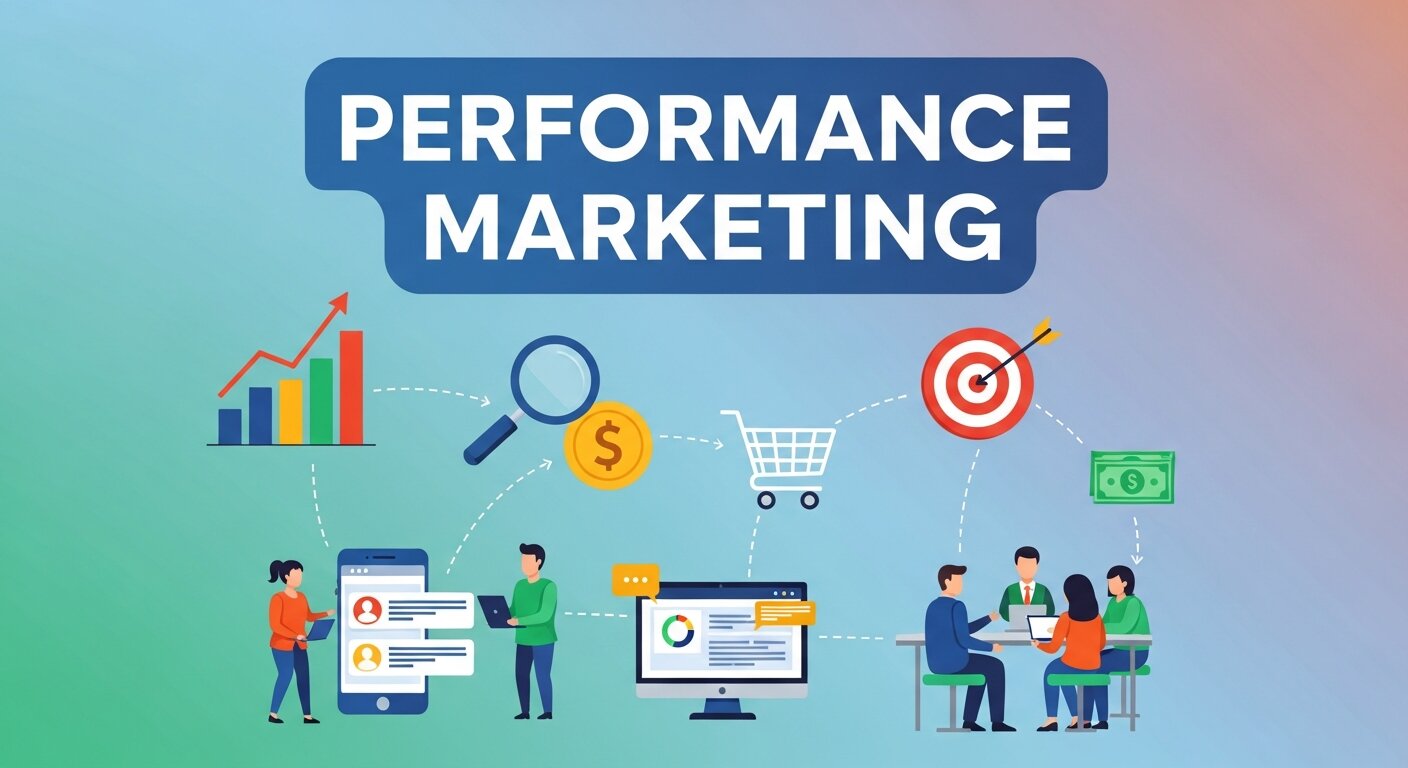
Mobile app marketing is no easy task. With millions of apps vying for attention in app stores, advertising your platform can often feel like shouting in the void. Enter: performance marketing. It’s a strategic, data-focused method that allows app developers and marketers to get high-performing users and optimize towards results they can measure.
If you’re releasing an app or looking to boost metrics for an app that’s already live, you may be wondering about performance marketing for mobile apps and how you can use it to take your app to the next level.
What is Performance Marketing
At its essence, Performance Marketing is an online marketing strategy in which advertising spend is directly tied to specific, measurable results. While typical marketing strategies concentrate on brand awareness, performance-based marketing is about actions. These activities could be anything – a new app install, sign up, purchase, or whatever else reflects engagement!
Performance marketing is a favorite of brands because they only pay for successful results, which translates into maximum ROI. This is especially useful for mobile apps where user acquisition costs can spiral out of control very quickly.
Performance marketing for mobile apps often takes the form of in-app ads, social media, search engine-promoted content, and affiliate partnerships. Performance marketing for mobile apps often takes the form of in-app ads, social media, search engine-promoted content, and affiliate partnerships.
Why Performance Marketing is Key for Mobile Apps
Laser-Like Focus on The Metrics That Matter
The theory behind performance marketing is that each campaign has KPIs (key performance indicators). These may be CPI, CPA, retention rates and LTV for mobile apps. Because by attaching marketing to such goals, you can guarantee a direct input towards growth.
Cost-Effective Advertising
No longer are ad budgets spent haphazardly. Performance Marketing With performance marketing, businesses can regulate their spending with accuracy. Whether you’re aiming for 20,000 installs or 10% increased user retention in first month after install, you only pay for what actually happens, not just the views or impressions.
Scalability and Flexibility
Performance marketing has the benefit of being incredibly scalable. If you do find a campaign that is producing great results then you can scale it easily. On top of that, the algorithms optimizing your audiences on platforms like Google Ads, Facebook and TikTok get better and better the longer you use them.
Data-Driven Insights
Data powers performance marketing. Every exchange, input and action is taken into consideration to build a picture of what is working and what is not. This means your campaigns get smarter, more efficient, and better in tune with what your audience is doing.
Elements of a Successful Performance Marketing Campaign

Know Your Audience
Before even running a campaign, you must define your user in detail. What is your app solving for? How old? Who are these people? What do they look like?
A fitness app, for instance, may zero in on health-conscious millennials who use activity trackers, while a meditation app may go after professionals seeking a stress release. Leverage analytics, market data, and social media intelligence for a stronger persona.
Get Your App Store Listing Right
Not even the most successful campaigns in the world will help you if your App Store page doesn’t entice. App Store Optimization (ASO) is often the starting gun for a successful performance marketing strategy. The ones to really focus on are:
- Optimize Title and Description with Focused Keywords
- Attractive app icons and screenshots to get some attention
- Providing social proof with app reviews and ratings
Choose the Right Channels
The success of your performance marketing efforts will rely on utilizing the channels most active with your audience. These are a few critical platforms to consider:
- Search Ads: Google App Campaigns work well if you are focusing on apps for users who are in the act of searching for solutions.
- Social Ads: Instagram, Facebook, Snapchat, and TikTok are all great platforms for visual storytelling and high user engagement.
- Affiliate Marketing: Collaborating with the people that matter or promoting from affiliate networks can help increase your conversions.
- Programmatic Ads: By leveraging algorithms, ads are shown across multiple channels to the people most likely to download your app.
Launch Retargeting Campaigns
Getting users is only half the battle. Performance marketing allows you to retarget potential users who might have fallen off the funnel — say someone who clicked on your ad but didn’t complete the download process. Dynamic retargeting ads are a way you can push these people to a certain action you’d like them to take.
Measure Your Metrics
Tracking your KPIs is not an option when it comes to performance marketing. Track KPIs like CPI, CPA, DAUs, retention rates, churn, through platforms such as Adjust, Appsflyer, Google Analytics, and others.
Leveraging user behavior data can help you locate stumbling blocks within your campaigns and adjust them for greater success.
Test and Optimize
Performance marketing is all about becoming better and better. Make your campaigns in such a way that A/B testing is just in the DNA. These tests might measure, for example, several different ad headlines, visuals or offers to understand which produce better results. Your campaigns should be increasingly profitable with each quality you increase.
Performance Marketing for Mobile Apps in Real Life
Example 1. Calm’s Social Media Dominance
The meditation app Calm blew up, thanks in large part to performance marketing, running social ad campaigns on Instagram and Facebook. Through creating aesthetically pleasing, aspirational ads for overworked professionals, Calm had exploded with app installs and had become known as a meditation.
Example 2. TikTok Happy Hours for Food Delivery Apps
One major food delivery app employed TikTok’s custom ad experience to produce shareable, enjoyable content about the ease of food delivery. The result? Lower user acquisition costs, and a marked rise in installs as well as in-app purchases.
Performance Marketing - Key Constraints
Performance marketing offers some tremendous benefits, but challenges include:
- The inflation of cost per install in hyper-competitive industries
- Keeping up with specific requirements set out by data privacy laws
- Ensuring a growing audience base
By taking proactive measures to resolve these, you will be able to ensure the long-term success of your campaigns.
How to Stay Competitive
Performance marketing is not a “set it and forget it” strategy. To never fall behind, brands need to stay data-driven, experiment creatively and keep on top of what’s coming up and coming out. Watch for trends like:
- Voice search optimization
- AI in campaign management
- Gaming ad placement
These offer fresh opportunities.
Start Driving Real Growth
Performance marketing is a lever of growth for mobile app developers and advertisers. Through your focus on measurability, targeting and optimization, you can attract users that aren’t just downloading — they’re engaging, subscribing and remaining loyal.
Need more performance marketing guidance? Reach out to us today to maximize your campaigns and get marinating your app’s success!
Building a Strong Pre-Launch Strategy

A successful performance marketing journey starts well before your app goes live. Pre-launch planning helps you validate demand, define early KPIs, and build anticipation among your target audience. During this phase, marketers often test messaging, visuals, and value propositions through small paid campaigns or landing pages. This allows teams to identify what resonates most with potential users before spending heavily. A structured App Marketing Playbook can help organize these efforts, outlining timelines, goals, and testing frameworks. By entering the market with data-backed assumptions rather than guesses, you reduce early acquisition risks and set a solid foundation for scalable growth once campaigns officially launch.
Creative Strategy That Converts Users
Creatives play a crucial role in performance marketing success. Even with perfect targeting, weak visuals or unclear messaging can kill conversion rates. High-performing app ads usually focus on showcasing real user benefits rather than just features. Short videos, user-generated content, testimonials, and problem-solution narratives tend to perform well across social platforms. Creative fatigue is also a real challenge, so refreshing assets frequently is essential. Testing multiple variations of visuals, copy, and CTAs helps identify winning combinations. Over time, performance data will reveal which creative elements drive installs, engagement, and retention, allowing marketers to continuously refine their approach.
Leveraging User Engagement Beyond Installs

Installs alone don’t define success—engagement does. Once users download your app, keeping them active becomes the next priority. Smart engagement strategies focus on guiding users toward key actions, such as completing onboarding or using core features. Personalized Push Notifications can play a major role here by reminding users of value at the right moment. However, timing and relevance are critical to avoid churn. Performance marketers often analyze user behavior to trigger messages based on inactivity or milestones. When engagement efforts align with acquisition campaigns, overall lifetime value increases, making marketing spend far more efficient.
Optimizing the Funnel for Higher Conversions
Every step in the user journey affects performance outcomes. From ad click to install and first interaction, friction at any stage can reduce conversions. Performance marketers regularly audit funnels to identify drop-off points and improve flow. This may include simplifying onboarding, improving loading speeds, or clarifying value propositions early. Strong App Store Optimization supports this process by ensuring users arrive at a compelling, consistent app store experience after clicking ads. When funnel optimization is treated as an ongoing process rather than a one-time fix, conversion rates steadily improve while acquisition costs decrease.
Attribution and Budget Allocation Strategy
Understanding where conversions come from is essential for scaling performance marketing. Attribution models help marketers identify which channels, creatives, and touchpoints contribute most to desired actions. With accurate attribution, budgets can be shifted toward high-performing sources and away from underperforming ones. This prevents wasted spend and improves overall ROI. Advanced attribution also enables smarter retargeting and cross-channel optimization. As privacy regulations evolve, marketers must adapt by using aggregated data and predictive modeling. A clear attribution strategy ensures decision-making remains data-driven even in a more restricted tracking environment.
Long-Term Growth Through Continuous Experimentation
Sustainable success in performance marketing comes from constant learning. Markets change, user behavior evolves, and platforms update their algorithms frequently. Brands that win long-term treat experimentation as a core mindset rather than an occasional task. This includes testing new ad formats, emerging platforms, bidding strategies, and audience segments. Even small incremental improvements can compound into significant gains over time. Regular experimentation also helps prevent stagnation and keeps campaigns competitive. By balancing proven tactics with controlled risk-taking, performance marketers can maintain growth while adapting quickly to new opportunities in the mobile app ecosystem.
Frequently Asked Questions (FAQ)
1. What is performance marketing for mobile apps?
Performance marketing for mobile apps is a results-driven advertising approach where marketers pay only for measurable actions such as app installs, sign-ups, purchases, or subscriptions. It focuses on tracking performance metrics to ensure every marketing dollar delivers tangible value.
2. How is performance marketing different from traditional app marketing?
Traditional app marketing often prioritizes brand awareness and impressions, while performance marketing is action-based. In performance marketing, campaigns are optimized around clear KPIs like cost per install (CPI), cost per acquisition (CPA), and user retention, making results easier to measure and scale.
3. Which channels work best for mobile app performance marketing?
Popular channels include search ads (Google App Campaigns), social media platforms like Facebook, Instagram, TikTok, and Snapchat, affiliate marketing networks, and programmatic advertising. The best channel depends on where your target audience spends time and how they discover apps.
4. What metrics should I track in mobile app performance marketing?
Key metrics include CPI, CPA, daily active users (DAU), retention rate, churn rate, lifetime value (LTV), and return on ad spend (ROAS). Tracking these metrics helps identify what’s working and where campaigns need optimization.
5. Is performance marketing suitable for new app launches?
Yes, performance marketing is especially effective for new app launches. It allows marketers to quickly test different audiences, creatives, and channels while controlling costs and scaling only the campaigns that deliver strong results.
6. How does retargeting help in performance marketing for apps?
Retargeting helps re-engage users who showed interest but didn’t complete a desired action, such as downloading or registering. By serving personalized ads to these users, brands can improve conversion rates and reduce overall acquisition costs.
7. What tools are commonly used to track mobile app performance?
Common tools include Appsflyer, Adjust, Google Analytics, Firebase, and attribution platforms that help track installs, user behavior, and conversions across marketing channels.
8. What are the biggest challenges in mobile app performance marketing?
Major challenges include rising cost per install, intense competition, ad fatigue, and privacy regulations affecting user tracking. Overcoming these requires continuous optimization, creative testing, and smart audience targeting.
9. How often should campaigns be optimized?
Campaigns should be monitored daily and optimized regularly. Performance marketing relies on continuous testing and refinement—small adjustments to creatives, targeting, or bids can significantly improve results over time.
10. Can performance marketing help improve user retention, not just installs?
Absolutely. While performance marketing often starts with acquisition, it also supports retention through retargeting, personalized messaging, and in-app engagement campaigns that encourage long-term user loyalty.


