
AI-Powered Personalization: Revolutionize Your App Marketing
 11 min read
AI-Powered Personalization leverages advanced-data-analysis and marketing-analytics to deliver tailored user experiences, boosting engagement, retention, and conversions while driving marketing-success through real-time insights, predictive models, and continuous optimization strategies.
In today’s digital landscape, mobile applications compete fiercely for user attention and loyalty. Generic outreach strategies no longer cut through the noise—people expect each interaction to feel bespoke, addressing their unique preferences and habits. AI-powered personalization transforms this expectation into reality by harnessing advanced algorithms to tailor content, interface elements, and marketing triggers in real time. Instead of static segments, applications evolve continually, responding to individual behaviors, feedback, and contexts.
By embracing AI-driven methodologies, brands can forge deeper connections, boost session frequency, and extend user lifetime value. Gone are the days of one-size-fits-all campaigns: now, predictive models anticipate churn risks, recommendation systems spark cross-sells, and natural language interfaces elevate support experiences. Operating this year , organizations that deploy such dynamic personalization gain a tangible competitive edge, driving engagement metrics well above industry benchmarks.
This article dives into the heart of AI-powered personalization for app marketing. You’ll discover how these intelligent systems work, which core technologies underpin them, and step-by-step guidance on orchestrating all customer data into actionable insights. We’ll also address privacy considerations, compliance best practices, and measurement frameworks that justify ROI. Whether you manage a rapidly scaling startup or oversee an established app portfolio, read on to learn how to unlock the full potential of AI personalization and deliver truly user-centric experiences.
What Is AI-Powered Personalization and Why It Matters
AI-powered personalization refers to the use of machine learning, predictive analytics, and real-time data processing to customize each user’s journey within an application. Unlike traditional segmentation—where audiences are bucketed into static groups—this dynamic approach continually analyzes in-app events, transaction histories, and engagement signals. As a result, it can anticipate user needs, surface relevant content, and adapt interfaces on the fly.
Today’s consumers crave relevance: a study by Harvard Business School indicates that relevant experiences significantly boost click-through rates and purchase intent (source: Harvard Business School). When you deploy AI personalization effectively, the app no longer feels like a generic shell but a bespoke tool attuned to each person’s goals. Whether you’re suggesting the next workout, recommending a relevant article, or adjusting push frequencies to avoid notification fatigue, finely tuned personalization drives higher retention and conversion outcomes.
Core to this methodology is continuous learning. As a user engages—browsing menus, completing levels, or wavering at a checkout step—the algorithms recalibrate predictions. This means every touchpoint becomes a new data point, fueling more accurate recommendations and smarter campaign triggers. In effect, AI personalization turns raw behavioral signals into meaningful experiences, making your app indispensable rather than disposable.
Key AI Technologies Powering App Personalization

Several foundational technologies converge to enable real-time, AI-driven customization. Understanding each component helps marketing and product teams select the right tools and architecture.
Machine Learning Models
Supervised and unsupervised learning algorithms sift through vast clickstreams, session durations, purchase histories, and more. By identifying hidden patterns, these models can forecast what content or offers will resonate. For example, collaborative filtering can suggest products based on similar user profiles, while clustering techniques identify micro-segments that manual analysis might overlook.
Natural Language Processing (NLP)
With Natural Language Processing (NLP) , chatbots and in-app messaging gain conversational context, interpreting user queries and responding with human-like fluency. This elevates customer support and engagement, as bots can surface personalized tips, troubleshoot issues, or even upsell premium features—all informed by previous interactions.
Recommendation Engines
Recommendation systems curate relevant content or merchandise by blending real-time behavior with historical preferences. Companies like Netflix and Amazon have popularized these engines, but even niche apps can benefit. Whether you’re suggesting new workout routines in a fitness app or complementary in-app purchases in a gaming environment, recommendation engines drive incremental revenue and deepen engagement.
Predictive Analytics
Predictive models forecast key performance indicators—churn probability, lifetime value, or campaign responsiveness—so teams can implement proactive measures. Spot a high-risk user? Trigger a tailored re-engagement sequence. Identify a segment with high earning potential? Surface premium features or subscription offers at the optimal moment.
Computer Vision and Sentiment Analysis
Emerging applications combine computer vision with emotional sentiment detection to tailor experiences even further. For instance, AR-driven retail apps can gauge user reactions in real time, adapting visual overlays based on mood indicators. Although still nascent, these modalities point toward hyper-contextual personalization in the near future.
Implementing Effective Personalization Strategies
Transitioning from theory to execution involves assembling the right data infrastructure, defining clear goals, and continuously refining your models. Here’s a practical roadmap to guide your team.
1. Unify Data Sources
Collect user signals from every touchpoint—signup forms, in-app interactions, CRM records, email engagement, and support tickets. Centralize this information in a customer data platform (CDP) to ensure a single view of each individual. Tools like Segment or Treasure Data can simplify ETL processes and feed unified profiles into your AI ecosystem.
2. Establish Personalization Objectives
Determine the outcomes you aim to achieve. Are you driving first-week activation, boosting subscription upgrades, or minimizing churn? Assign measurable KPIs—onboarding completion rates, in-app purchase frequency, or net promoter scores (NPS)—to track progress.
3. Train and Validate AI Models
Work with data science teams or leverage pre-built solutions to train algorithms on historical data. Always reserve a holdout set for validation to avoid overfitting. Common frameworks include TensorFlow, PyTorch, and scikit-learn, but enterprise-grade platforms often provide turnkey personalization modules if you lack in-house expertise.
4. Automate Content Delivery
Integrate your AI predictions with marketing automation platforms like Braze or Iterable. Set up triggered push notifications, in-app banners, and email sequences that deploy when AI flags specific user states—such as high churn risk or readiness to convert.
5. Iterate and Optimize
Monitor open rates, click-throughs, session lengths, and revenue uplifts continuously. Leverage A/B testing to compare AI-personalized experiences against generic controls. Retrain models on fresh data to capture shifting user behaviors—today’s popular features may be obsolete next quarter.
While AI-driven customization offers compelling benefits, it’s essential to respect user privacy and adhere to regulations such as GDPR and CCPA. Mishandling personal data can erode trust and expose your organization to substantial fines.
Balancing AI-Powered Personalization with Privacy and Compliance
As AI-Powered Personalization becomes central to modern app marketing, businesses must strike a balance between delivering hyper-relevant experiences and safeguarding user data. While advanced-data-analysis enables deeper insights, it also increases responsibility around ethical data usage, transparency, and compliance.
Failing to address privacy concerns can damage brand trust and hinder long-term marketing-success. Therefore, organizations must implement robust frameworks that align personalization strategies with global data protection standards.
Key Privacy and Compliance Best Practices

1. Obtain Explicit User Consent
Transparency is the foundation of trust. Before collecting any personal data, businesses should:
- Clearly explain what data is being collected and why
- Use simple, non-technical language in consent forms
- Provide granular consent options (e.g., marketing emails, push notifications)
- Ensure compliance with regulations like GDPR and CCPA
This approach not only ensures legal compliance but also improves user confidence and engagement.
2. Anonymize and Encrypt Sensitive Data
Data security is critical when leveraging marketing-analytics for personalization.
- Replace personally identifiable information (PII) with anonymized identifiers
- Store sensitive data separately from behavioral datasets
- Use strong encryption protocols (AES-256, TLS)
- Regularly update security systems to prevent vulnerabilities
This minimizes risk while still enabling powerful AI-driven insights.
3. Respect User Opt-Out Preferences
Users should always have control over their data.
- Provide easy-to-access opt-out settings
- Immediately stop data tracking after opt-out
- Sync preferences across all systems and channels
- Avoid re-targeting users who have opted out
Respecting user choices builds long-term loyalty and brand credibility.
4. Implement Strong Data Governance Policies
A structured governance model ensures responsible data handling across teams.
- Define clear roles (data owners, processors, compliance officers)
- Establish data retention and deletion policies
- Conduct regular audits of AI models and data pipelines
- Ensure fairness and eliminate bias in algorithms
Effective governance supports ethical AI adoption and sustainable growth.
Measuring Success and Future Outlook of AI-Powered Personalization
To justify investments in AI-Powered Personalization, businesses must rely on data-driven evaluation frameworks. Combining marketing-analytics with advanced-data-analysis allows teams to measure both immediate performance and long-term impact.
A well-defined measurement strategy not only validates ROI but also uncovers opportunities for continuous optimization.
Key Performance Indicators (KPIs) to Track
Engagement Metrics
Measure how users interact with your app:
- Session frequency
- Average session duration
- Screen views per session
Higher engagement indicates successful personalization.
Conversion Metrics
Evaluate how personalization drives actions:
- In-app purchases
- Subscription upgrades
- Feature adoption rates
Improved conversions directly contribute to marketing-success.
Retention & Churn Metrics
Understand long-term user behavior:
- Day 1, Day 7, Day 30 retention rates
- Churn prediction accuracy
- Customer lifetime value (CLV)
Strong retention reflects meaningful user experiences.
Customer Satisfaction Metrics
Gauge user perception and loyalty:
- Net Promoter Score (NPS)
- App ratings and reviews
- Customer feedback trends
Positive sentiment confirms personalization effectiveness.
Performance Measurement
| Metric Category | What It Measures | Why It Matters | Example KPI |
|---|---|---|---|
| Engagement Metrics | User interaction with the app | Indicates relevance of personalized experiences | Session duration, DAU/MAU |
| Conversion Metrics | User actions and goal completions | Shows revenue and growth impact | Purchase rate, upgrade rate |
| Retention & Churn | User loyalty and drop-off trends | Reflects long-term value and satisfaction | Retention rate, churn rate |
| Customer Satisfaction | User sentiment and experience quality | Measures trust and brand perception | NPS, app ratings |
| Predictive Accuracy | AI model performance | Ensures effectiveness of personalization algorithms | Churn prediction accuracy |
Future Outlook: What’s Next for AI Personalization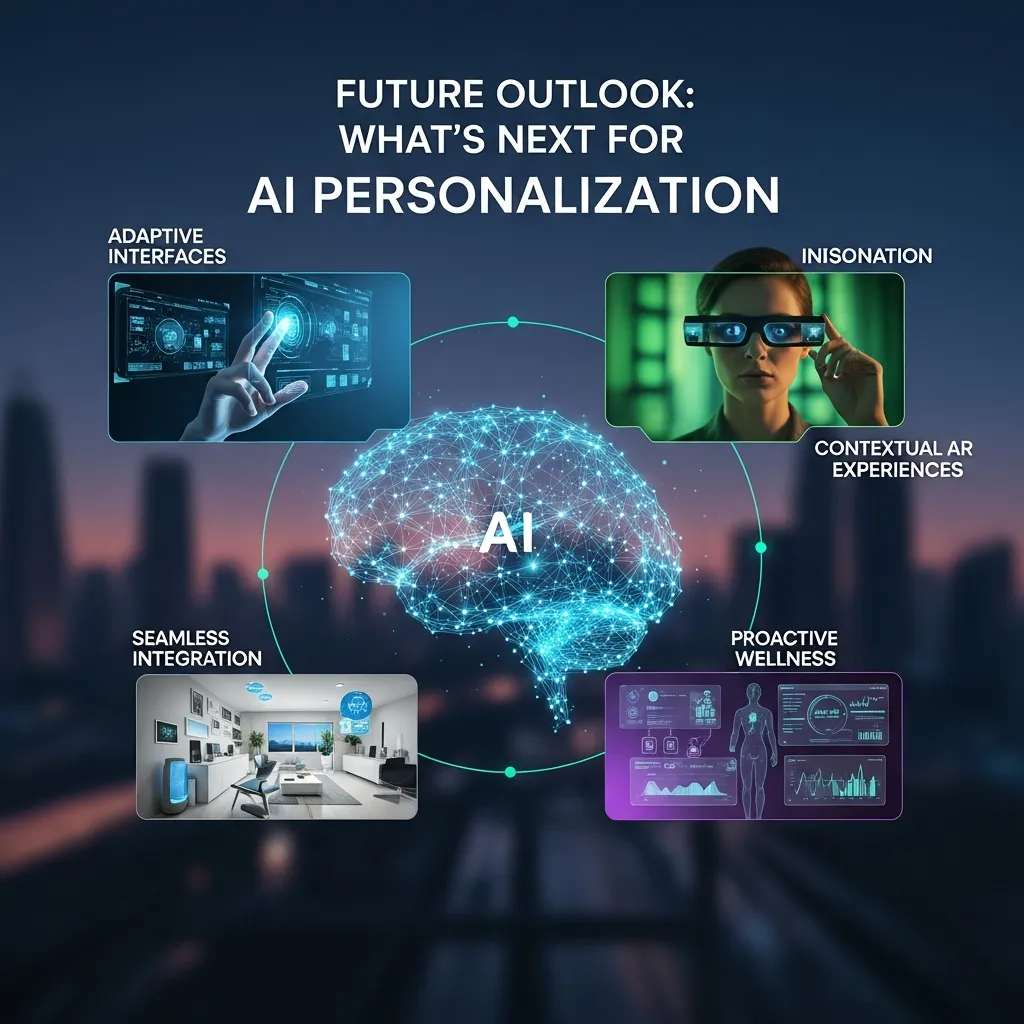
The future of AI-Powered Personalization is driven by real-time intelligence and contextual awareness. Emerging innovations include:
- Contextual AI: Adapts experiences based on location, device, and real-time behavior
- Voice & Conversational AI: Enables natural, human-like interactions
- Augmented Reality (AR): Delivers immersive, personalized visual experiences
- Hyper-Automation: Fully automated customer journeys powered by AI
Brands that embrace these trends early will gain a significant competitive advantage and redefine marketing-success in 2026 and beyond.
A/B and Multivariate Testing
Use split testing to validate specific personalization tactics. For instance, compare the performance of dynamically tailored push notifications versus generic announcements. Blend multivariate experiments to fine-tune message copy, timing, and channel mix.
Emerging Trends to Watch
Looking forward, contextual AI will take personalization beyond behavioral history, incorporating real-time factors like location, device status, and even biometric signals. Voice-enabled assistants will offer hands-free, conversational engagement, while augmented reality (AR) overlays could provide hyper-relevant promotions in physical environments. Brands that experiment early with these frontiers will shape user expectations for the next generation of mobile experiences.
AI-powered personalization represents a transformative leap in how apps interact with users in today’s mobile ecosystem. By integrating advanced analytics, machine learning models, and real-time data orchestration, organizations can craft experiences that evolve alongside each user’s journey. The result is deeper engagement, higher retention rates, and increased revenue potential.
To succeed, begin by unifying data streams, defining measurable personalization goals, and selecting appropriate AI technologies. Prioritize user privacy and compliance to build lasting trust, and implement robust measurement frameworks to demonstrate ROI. Finally, remain agile—continually retrain models, conduct A/B tests, and explore emerging modalities like contextual AI and AR. Taking these steps today will position your brand at the forefront.
FAQ: AI-Powered Personalization in App Marketing
1. What is AI-powered personalization in app marketing?
AI-powered personalization uses machine learning and advanced-data-analysis to tailor app experiences, content, and marketing messages based on individual user behavior, preferences, and real-time interactions.
2. How does AI-powered personalization improve marketing success?
By delivering relevant content at the right time, AI-powered personalization increases engagement, boosts conversion rates, and enhances customer retention—key drivers of overall marketing-success.
3. What data is required for effective AI-powered personalization?
It relies on user data such as demographics, browsing behavior, purchase history, in-app interactions, and engagement metrics collected through marketing-analytics platforms.
4. Which industries benefit most from AI-powered personalization?
Industries like eCommerce, mobile apps, fintech, gaming, and healthcare benefit greatly, as they rely heavily on user engagement and personalized experiences to drive growth.
5. What role does advanced-data-analysis play in personalization?
Advanced-data-analysis helps uncover patterns, predict user behavior, and optimize content delivery, making personalization more accurate and impactful.
6. Is AI-powered personalization expensive to implement?
Not necessarily. Many SaaS tools and customer data platforms offer scalable solutions, making AI-powered personalization accessible even for small and mid-sized businesses.
7. How can businesses measure the success of personalization strategies?
Success is measured using marketing-analytics metrics like conversion rates, retention rates, session duration, customer lifetime value (CLV), and engagement levels.
8. How often should AI personalization models be updated?
Models should be retrained regularly—monthly or quarterly—depending on data changes, to maintain accuracy and adapt to evolving user behavior.
9. What are the privacy concerns with AI-powered personalization?
Key concerns include data security, user consent, and compliance with regulations. Businesses must follow best practices like data encryption, anonymization, and transparent opt-in policies.
10. Can small teams implement AI-powered personalization effectively?
Yes, small teams can leverage no-code or low-code tools with built-in AI capabilities, enabling them to execute personalization strategies without deep technical expertise.


App Store Optimization Tips for Improving App Visibility and Downloads

AI-Powered App Marketing: Boost Acquisition & Retention
Supercharge App Growth with AI-Powered Chatbots